Showing posts with label Education. Show all posts

Monday, 16 November 2009

Finnish perceptions of educational challenges: Previous Research

The drawbacks of the Finnish education system deserve addressing as well.  
  • The Finnish education system has the danger of resting on its laurels.  Room for improvement still exists!
  • There is "meager" attention paid to gifted students, and the education system needs to further develop the skills of the academically talented.  
  • There are gender differences: girls attain higher scores in reading literacy than boys.
  • School students expressed negative perceptions of school climate and school satisfaction in the PISA questionnaires.
  • Swedish-speaking Finns score lower than the Finnish-speaking Finns in PISA.  
  • As the population of the country grows increasingly heterogeneous, many acknowledge the difficulty in adhering to the ethos of equality.  


Tuesday, 27 October 2009

Finnish perceptions of PISA Success: Previous Research, Part One

Finland's success in PISA has led to publications both within and outside Finland addressing the issue.

The University of Jyvaskyla, a respected university in Finland, and especially respected for the caliber of the Department of Education, released two articles on the matter.

A document entitled "The Finnish Success in PISA -- And Some Reasons Behind It: PISA 2000" was written in 2002 by Professors Valijarvi, Linnakyla, Kupari, Reinikainen, and Arffman. A similar document addressed entitled "The Finnish Success in PISA -- And Some Reasons Behind It 2" was released in 2007 and was written by Professors Valijarvi, Kupari, Linnakyla, Reinikainen, Sulkunen, Tornroos, and Arffman.

The second document described the Finnish reaction to high outcomes in PISA and the paradigm shift of educational interest that occurred after the release of PISA results:
The outstanding success of Finnish students in PISA has been a great joy but at the same time a somewhat puzzling experience to all those responsible for and making decisions about education in Finland. At a single stroke, PISA has transformed our conceptions of the quality of the work done at our comprehensive school and of the foundations it has laid for Finland's future civilisation and development of knowledge. Traditionally, we have been used to thinking that the models for educational reforms have to be taken from abroad. This sudden change in role from a country following the example of others to one serving as a model for others reforming school has prompted us to recognise and think seriously about the special characteristics and strengths of our comprehensive school (Valijarvi, et al., 2007, p. 3).

Tuesday, 28 July 2009

PISA Results for 2003: Scores for Swedish-Speakers

For the 2003 PISA survey, the Finnish PISA team incorporated all of the Swedish-speaking schools in the PISA sample.  

They published the findings with a separate score for the Swedish-speakers.  

Here are the scores for the 2003 survey:

Photobucket

Photobucket

Photobucket

Photobucket
Therefore, the 2003 PISA data shows that Swedish speakers score lower than Finnish speakers.  The blue bar in the graph shows the average scores of all participants in Finland, not just Finnish speakers.  

Education for Swedish-Speaking Finns: Part Five

More recently, these events have happened:
  • Resettlement of Finnish refugees
  • Post-War reconstruction
  • Increased Finnish economic power
  • Finnish nationalism
These events have led to intermarriage between the two language groups, lessening the stronghold of the Swede-Finn identity.

Although the percentage of Swedish-speakers has remained constant over the years, their percentage in the overall Finnish population has decreased.

Language shifting occurred, and Finnish became the language of the labor market.  

Swedish-speakers also emigrate to Sweden, further decreasing their percentage in the Finnish population.  

In 1977, Paulston stated, "The Swede-Finns continue to surpass national education norms, and especially those SF [Swedish-speaking] youth who live in towns and regional urban centers ... The continuing high priority of urban Swede-Finns on formal schooling is apparent." 

Education for Swedish-Speaking Finns: Part Four

Between 1880 and 1881, Swedish-speaking students numbered 1,764 while the total of Finnish-speaking students came only to 786.  In 1908-1909, however, the Swede-Finn numbers remained constant at 1,771 while the number of Finnish students grew to 4,756.  

During the 1920s and 1930s, Finnish-speaking university students battled for the "Finnification" of the University of Helsinki.  The prevalence of Swedish-speaking professors and Swedish as the language of instruction placed a great onus on the Finnish speakers.  

The large number of Swedish schools and large size of the Swedish-speaking upper class encouraged an "overproduction" of Swedish-speaking university students in comparison to the size of the Swede-Finn population (Paulson, 1977).  Today, the University of Helsinki still has a quota for Swedish-speaking students and professors, and Abo Akademi in Turku caters only to Swedish speakers.  

The separate education for Swede-Finns reflects the mutual acknowledgment of the difference between both linguistic groups.  

Education for Swedish-Speaking Finns: Part Three

With Finnish independence came official bilingualism, and with this, the Swedish-speaking Finns pursued a policy of cultural autonomy and separatism.  Along with this came separate Swedish-speaking schools.  
The Constitution of Finland clearly defines the rights of education in the Swedish language.  In Section 17, the Constitution confirms the two national languages of Finland, and asserts the right to use the mother tongue in official capacities, such as courts of law and government documents. It also affirms the provision for cultural and societal necessities, on an equal basis, in the mother tongue.  

In 1920, with the founding of the Swedish Department in the Central Bureau of Schools, both Swedish schools and Finnish schools held, legally, an equal position.  

This advantageous minority position does not find  a parallel with the Finnish-speaking minority in Sweden.  

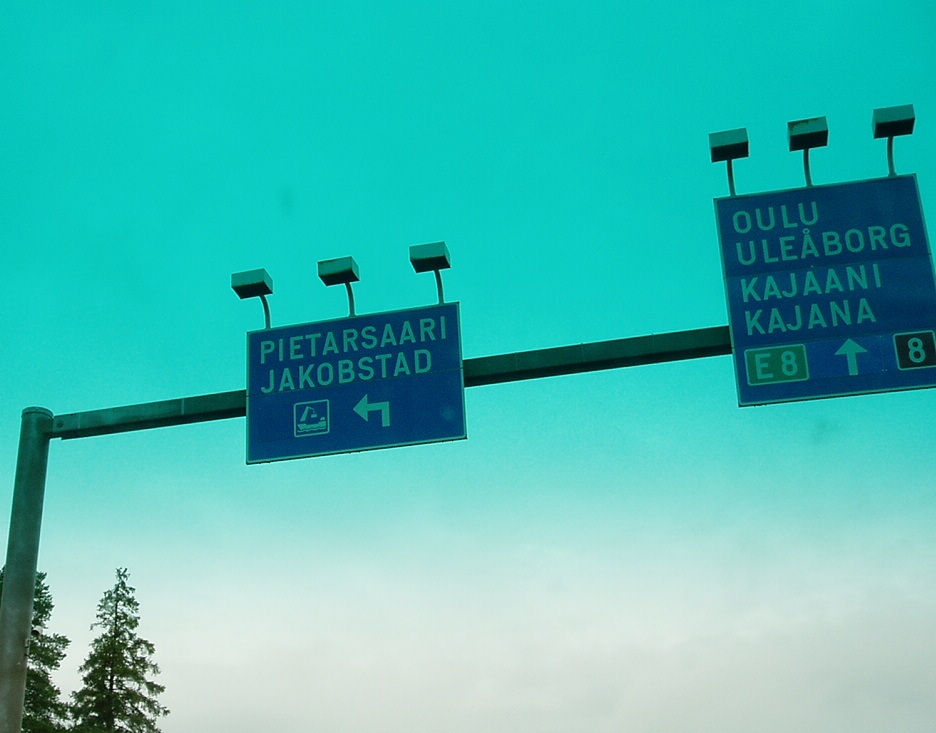
Click here and here and here for pictures of signs in both the Finnish and Swedish languages.  

Click here for a map of Finland showing the Swedish-speaking areas.  

Education for Swedish-Speaking Finns: Part Two

In response to the Finnish nationalist movement in the mid-19th century, the Swedish-speakers started their own counter movement, but only in the interests of the upper classes.  The common Swedish-speakers did not have a part in this movement.  Many viewed the Finnish language as the language of peasants and felt superior to Finnish speakers.  

In 1906, Swede-Finns founded the Swedish People's Party in order to unite the entire Swedish-speaking population in Finland, irrespective of social class.  

The uniting of Swede-Finns supports their view that Finland, much like Switzerland or Belgium, has a culturally and linguistically pluralistic society, and that both nationalities and linguistic groups have existed side-by-side throughout Finland's history.  

Education for Swedish-Speaking Finns: Part One

Swedish-speaking Finns, called finlandssvenskar in Swedish and suomenruotsalaiset in Finnish, hold a unique place in Finnish society.  
The Swede-Finns constitute a "declining cultural, economic, and social elite [which] has sought to maintain ethnic identity boundaries through control of a separate Swedish-speaking school system and widespread non-formal educational efforts" (Paulston, 1977).  

According to Paulston, separate schooling allowed the Swede-Finns to maintain the survival of their minority group.  Although a minority, Swedish-speaking Finns had an atypical role compared to other ethnic minorities.  They constituted a high percentage of the economic and social elite of Finland, with "superior resources, historical dominance, and psychological advantage" (Paulston, 1977).  

Education for Saame

The Saame, or Sami, the indigenous people of Lapland, have constitutional rights to cultural autonomy.  They have their own parliament that has educational influence.  For the municipalities located in the Sami areas, pupils learning the Sami language must have the provision of primary education in the language, if requested by the parents.  Education in the Sami language, therefore, does exist in the Sami-speaking areas of Lapland.  

LUMA

In the 1990s, LUMA was born.  The LU in LUMA stands for luonnontieteet, or natural science, and the MA stands for matematiikkaa, or mathematics.  LUMA began in 1996 as an attempt to improve skills in science and mathematics.  

Jointly supported by the general school and vocational school tracks, LUMA attempted to raise interest in science and mathematics as well as achievement in those areas, especially among girls. 

The Ministry of Education, National Board of Education, universities with teacher training courses, municipalities, and schools all had stakes in the project.  

Tertiary Education

At the tertiary level, students can attend a polytechnic or a university.  

Polytechnics focus on a more practical training of professionals for their careers.  Currently, Finland has 29 polytechnics, most having good connections to business and industry.  

Finland's first university was founded in 1640 in the city of Turku.  When the capital moved to Helsinki in the early 19th century, the university moved as well.  Not until independence did more universities emerge.  The university network today includes nearly every subject and enjoys geographical distribution all around Finland.

The state administers the universities, but they have widespread autonomy.  Polytechnics have municipal or private administration.  

Students enter university through entrance exams.  The polytechnics differ from universities as they have a more practical focus.  For example, doctors receive their education through universities, while nurses do so through polytechnics.  Engineers can take either path, and they are referred to as insenoori or diplomi-insenoori indicating whether they have studied at a polytechnic or university, respectively.  

The education reforms of the 1990s upgraded the polytechnics to the higher education level.  Polytechnics also gained the ability to grant master's degrees, undertaken after three years of work experience by the candidate.  

Monday, 27 July 2009

Vocational Education

Some students choose to continue their education in the vocational track.  They learn in a school environment, but do have some work-based learning as well.  

The apprenticeship schemes in vocational schools have expanded recently, and approximately 10% of the vocational course takes place in an apprenticeship environment.  

Institutions carrying out vocational education receive a license from the Ministry of Education, but municipalities and companies carry out the education itself.

In initial vocational education, students can receive 53 qualifications out of 116 study programs. The qualifications can come under seven sectors of vocational study:
  1. Natural sciences
  2. Technology and transport
  3. Social sciences, business and administration
  4. Tourism, catering, and home economics
  5. Health and social services
  6. Culture
  7. Leisure and physical education
  8. Humanities and teaching
Vocational education and training in Finland believes in giving students the knowledge and skills necessary for vocation competence and employment, in addition to knowledge and skills needed for further studies and lifelong learning.  Therefore, students in the vocational sector have 1/3 of their curriculum filled by general studies. 

Recently, it has become popular for students to gain qualifications in both the academic and vocational sectors of upper-secondary education.  10% of students in the vocational track take classes in the general upper-secondary schools, and 8% take the matriculation exam.  

Upper-Secondary School

After compulsory school, students can choose between upper-secondary school and vocational school.  Students may choose an optional tenth year of compulsory school, if they feel they need more time in compulsory school to improve grades or better select post-compulsory school options.  

Approximately half of the continuing students choose upper-secondary school and half choose vocational education.  Students applying to upper-secondary school fill out an yhteiskaku, an application based on their marks from school and also lists their preferences for upper-secondary school.  

Enrollment in both sectors of upper-secondary education have increased in the past few decades.  97% of students completing compulsory education continue on to upper-secondary school.  Students completing the vocational track sometimes enter the academic track after the completion of their course, and vice versa.  

In both sectors, students have both mandatory and elective subjects.  In general upper-secondary school, students have compulsory courses and choose at least ten advanced courses for the three-year duration of school. 

Much like compulsory school, local authorities have responsibility for general upper-secondary schools.  

A matriculation examination takes place after the completion of upper-secondary general education.  The National Core Curriculum provides the basis for the examination, which has a minimum of four tests: the compulsory mother tongue examination, plus three assessments chosen from the second national language, mathematics, foreign language, and general studies.  The matriculation certificate gives eligibility to enter tertiary education.  

School Evaluation

Finnish schools self-evaluate; in other words, they have no school inspectorate.  The government entrusts the schools, the providers of education, to carry out the National Core Curriculum and to evaluate and monitor their own quality.  

This school self-evaluation occurs every three years. It consists of surveys with parents, personnel, and students, in addition to teacher meetings over different issues within the school.  

An example:  School evaluation in Helsinki takes into account these factors:
  1. School achievement compared to national samples
  2. Parental opinions
  3. Health reviews
  4. Curriculum evaluations
  5. Evaluating the annual plan
Schools start the year with an annual plan, and use these self-evaluations to ascertain if they have achieved their goals.  The ethos of self-evaluation implies a culture of trust within schools, and therefore eliminates the need for inspectorates and league tables.  The Evaluation Council for Education and Training works with the Ministry of Education to aid the self-evaluation of schools.  

Assessment

Assessment in Finnish schools comes strictly from the teachers.  The decentralized nature of Finnish education allows for this.  

Primary schools do not use testing in order to concentrate on teaching.

After fifth grade, the law prohibits numerical grading in order to prevent student competition.  

Each student receives a report once a year, and teachers may administer an additional report halfway through the year.  

At the end of compulsory school, students receive a certificate of completion.  

Special Needs Education

Finnish schools provide extensive special needs education.  The schools provide special support for students with difficulties, disorders, and disadvantages.  

All students have the right to the same educational objectives and possibilities; therefore, students with various difficulties have the right to individual support.  The extent of this support depends on the extent of the difficulties.  

The Basic Education Act defines students with special educational needs as those affected by illness, disability, or reduced functional ability, those who need more mental or social support, or the students who have risk factors in their development that affect their learning.  

The philosophy aims first to include students within the mainstream classroom, in order to provide them with the same opportunities as their peers.  The second option provides special education in a separate class, group, or school.

In 2006, 7.7% of students received special education, while in 1998, 3.8% of students needed more attention.  The Board of Education attributes this to better diagnosis of disabilities such as dyslexia.  

Basic or Compulsory School

Basic or compulsory school covers nine years and begins at the age of seven. Some 99.7% of students complete basic school in Finland, which gives it one of the lowest dropout rates in the world. In the 2006-2007 school year, the entire country had 350 school dropouts.  

The government finances the education, but the municipalities control the spending of the money for local schools.  

Local authorities assign a place in school for each student, close to their homes. However, the students have school choice and can apply for a place at another school. Basic education is the responsibility of the municipalities.  

The system has full, public financing. 

The current system of education comes from the reforms on the 1970s (see previous post). The reforms combined the Finnish equivalent of primary school, secondary modern school, and middle school into the nine-year compulsory school.

You can read more about secondary modern school here and here.  

Compulsory school breaks down into two sections, the lower stage and the upper stage.  The lower stage lasts six years and the upper stage lasts three years.  In the first six years of compulsory school, students have classroom teachers, and in the last three years, they have subject teachers.  In the upper stage, students have both mandatory and optional subjects.  

The National Core Curriculum

The National Core Curriculum, created by the Finnish National Board of Education, provides teachers with a plan of educational objectives as well as assessment criteria.  Although the board of education lays down the guidelines, the municipalities and schools place the curriculum into the local context, and the teachers hold the responsibility  of carrying out the curriculum as they see fit.  

In 1970, Finland introduced the first national curriculum, with strong centralization.  The curriculum has undergone three reforms since its inception, in 1985, 1994, and 2004.  

In 1985, the National Curriculum became the National Core curriculum, with increasing emphasis on a municipally-based syllabus.  The reforms also abolished ability grouping and increased eligibility to studies after compulsory education.

In 1994, the reforms delegated power further to the municipalities and schools.  The changes also abolished school inspections, encouraged cooperative learning, and created a "thinner" core curriculum.

The 2004 reforms reversed the curricular reforms and strengthened the core curriculum.  It also re-distributed the lesson hours, emphasizing goals instead of content.  The reforms in general have strengthened the roles of local authorities and schools, and stress the relevance of local and school-specific curricula.  They have also increased the role of student welfare and special education, in addition to individualized student learning.  Although the reforms of 2004 have increased the control of the local authority over the curriculum, the latest reform has applied more regulations to the National Core Curriculum, for the Board of Education felt it needed to provide more guidance.  

Expenditure in Education

Finland spends approximately 10 Billion Euros per year on education.  Within this expenditure, Finland spent the following percentage of the budget in each educational sector in 2005:
  • Pre-primary (six-year-olds) - 2.9%
  • Basic education - 36.5%
  • Upper secondary general education - 6.4%
  • Vocational education and training - 14.7%
  • Higher Education: Polytechnics - 7.8%
  • Higher Education: Universities - 17.9%
  • Other education - 3.9%
  • Administration - 2%
  • Financial aid - 7.8%

The Organization of Teaching and Learning

The organization of teaching and learning in Finland comes from four areas:
  1. The Basic Education Act and Decree (see previous post)
  2. The Government's Decree: give more detailed goals of education
  3. The National Core Curriculum (details to come in a future post)
  4. The Municipal and School Curricula: the implementation of the national curriculum according to local needs.